
Teams & Organizations
We study how small groups learn, coordinate, and solve problems, uncovering the mechanics of collective intelligence at the team scale.
Our research on teams and organizations examines how human groups coordinate, communicate, and accumulate the collective knowledge needed to solve complex problems. We study organizations as dynamic learning systems, shaped by their communication patterns, social networks, and diversity of expertise.
Our work explores the structure of organizational communication, through projects like Immersion and OpenTeams, the dynamics of real time decision making, through escape room experiments, and how demographic differences affect collaborative outcomes.
Together, these strands form a broad research program on how teams organize themselves, how knowledge circulates within and across groups, and how communication patterns shape performance.
For students and researchers, the Center for Collective Learning provides a space to investigate the social architecture of collaboration—from micro-scale team interactions to large-scale organizational networks—using methods that span computation, experimentation, theory, and data science.
Structure of Communication

IMMERSION (2013)
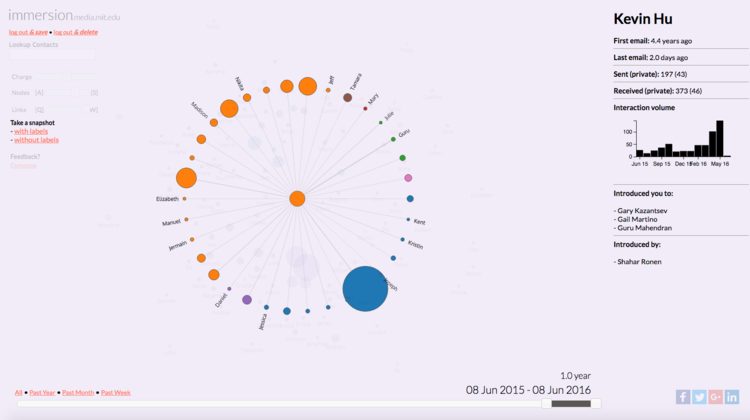
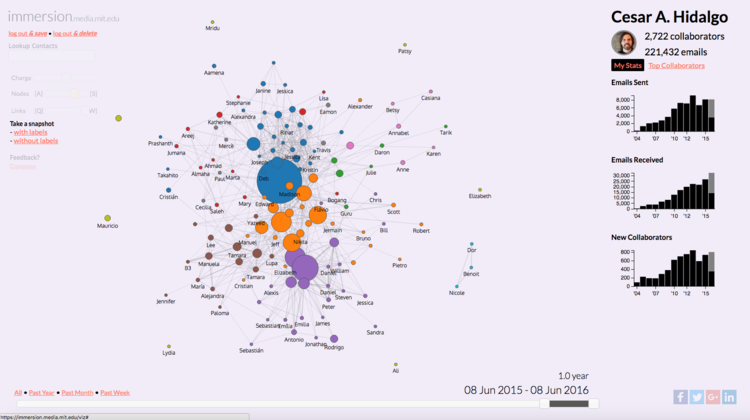
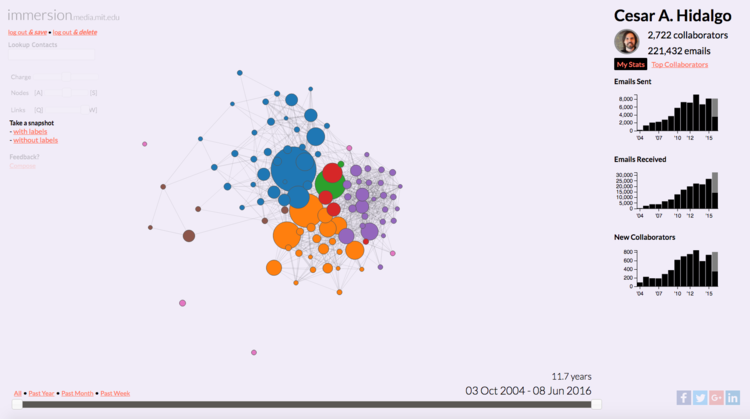
The current interface of emails is designed around time, and messages, pushing people to focus on what is more recent rather than important. Immersion is a design experiment that centers the email interface on people and the networks that people form.
Immersion was developed by Daniel Smilkov and Deepak Jagdish as part of their requirement for a Masters in Media, Arts, and Sciences.
OPENTEAMS (2018)
OpenTeams is an open source platform to visualize team data. It is designed for email metadata, and also, includes validated surveys regarding personality (big five) and morals (moral foundation).
OpenTeams was created at the MIT Media Lab by Jingxian Zhang, with the support of Diana Orghian and Xiaojiao Chen.
Resources
Jingxian Zhang thesis on OpenTeams (link)
Daniel Smilkov’s thesis on Immersion (link)
Deepak Jagdish’s thesis on Immersion (link)
Immersion Open Source repository (github)
OpenTeams Open Source repository (github)
Press Appearances
NPR, Time, Mashable, Phys.org, Press Citron, Generation-nt, The Conversation, El Diario, Boston Globe, Wired, ACLU(1), ACLU(2).
Related Papers
PAPERS, PROCEEDINGS, BOOK CHAPTERS & REPORTS
16.-AUTISM SHAPES SOCIAL INTEGRATION AND RECIPROCITY IN ELEMENTARY CLASSROOMS
Patricia Soto-Icaza, Melanie Oyarzun, Tamara Yaikin, Mirla Arcos-Polanco, Cristian Candia, Carlos Rodríguez-Sickert & Pablo Billeke
Scientific Reports (2025)
Published Version (PDF)
15.-QUANTIFYING BEHAVIOR-BASED GENDER DISCRIMINATION ON COLLABORATIVE PLATFORMS
Orsolya Vásárhelyi, Balázs Vedres
PNAS Nexus (2025)
Published Version (PDF)
14.-FAVORITISM UNDER MULTIPLE SOURCES OF SOCIAL PRESSURE
Gábor Békés, Endre Borza, Márton Fleck
Economic Inquiry (2024)
Published Version
13.-FAULTLINES, FAMILIARITY, COMMUNICATION: PREDICTORS AND MODERATORS OF TEAM SUCCESS IN ESCAPE ROOMS
Rebeka O. Szabó, Federico Battiston, and Júlia Koltai
Small Group Research (2024)
Published Version (PDF)
12.-INTEGRATING REINFORCEMENT LEARNING AND OPTIMIZATION TASK: EVALUATING AN AGENT TO DYNAMICALLY SELECT PSO COMMUNICATION TOPOLOGY
Lira, R. C., Macedo, M., Siqueira, H. V., & Bastos-Filho, C.
International Conference on Swarm Intelligence, Cham: Springer Nature Switzerland (2023)
Published Version (PDF)
12.-APPLYING REINFORCEMENT LEARNING FOR MULTIPLE FUNCTIONS IN SWARM INTELLIGENCE
Andre A. Ribeiro, E., Lira, R. C., Macedo, M., Siqueira, H. V., & Bastos-Filho, C
Brazilian Conference on Intelligent Systems, Cham: Springer Nature Switzerland (2023)
Published Version (PDF)
11.-THE POLICY IMPLICATIONS OF ECONOMIC COMPLEXITY
César A. Hidalgo
Research Policy (2023)
Published Version (PDF)
10.-HARNESSING COLLECTIVE INTELLIGENCE FOR THE FUTURE OF LEARNING–A CO-CONSTRUCTED RESEARCH AND DEVELOPMENT AGENDA
Dusan Misevic et al. including Mariana Macado from CCL
Human Computation (2023)
Published Version (PDF)
9.-BRIDGING THE POLARIZATION GAP: MAXIMIZING DIFFUSION AMONG DISSIMILAR COMMUNITIES
Marcin Waniek and César A. Hidalgo
Collective Intelligence (2022)
Published Version (PDF)
8.-RECIPROCITY HEIGHTENS ACADEMIC PERFORMANCE IN ELEMENTARY SCHOOL STUDENTS
Cristian Candia, Melanie Oyarzún, Victor Landaeta, T. Yaikin, Cecilia Monge, César A. Hidalgo and Carlos Rodriguez-Sickert
Heliyon (2022)
Published Version (PDF)
7.-HUMANS JUDGE FACES IN INCOMPLETE PHOTOGRAPHS AS PHYSICALLY MORE ATTRACTIVE
Diana Orghian and César A. Hidalgo.
Scientific Reports (2020)
Published Version (PDF)
6. DISCONNECTED, FRAGMENTED, OR UNITED? A TRANS-DISCIPLINARY REVIEW OF NETWORK SCIENCE
CÉSAR A. HIDALGO
Applied Network Science 1(1) (2016)
Published Version (PDF)
5. TO EACH ACCORDING TO ITS DEGREE: THE MERITOCRACY AND TOPOCRACY OF EMBEDDED MARKETS
JAVIER BORONDO, FLORENTINO BORONDO, CARLOS RODRIGUEZ-SICKERT, AND CÉSAR A. HIDALGO
Scientific Reports 4 (2014)
Published Version (PDF)
PRESS: Serious Science | PhysOrg | Fast Company
4. THE VALUE IN THE LINKS: NETWORKS AND THE EVOLUTION OF ORGANIZATIONS
CÉSAR A. HIDALGO
Chapter 32 for Sage Handbook on Management and Complexity (2011)
edited by P. Allen, S. Maguire and B. McKelvey
Pre-Print
3. THE DYNAMICS OF A MOBILE PHONE NETWORK
CÉSAR A. HIDALGO, CARLOS RODRIGUEZ-SICKERT
Physica A (2008), 387(12): 3017-3024
Published Version (PDF)
PRESS: Physorg | The Lede | Contexts Crawlers | Vision Universitaria | La Scienze
2. CONDITIONS FOR THE EMERGENCE OF SCALING IN THE INTER-EVENT TIME OF UNCORRELATED SEASONAL SYSTEMS
CÉSAR A. HIDALGO
Physica A. Vol. 369(2) p 877-883. (2006)
cond-mat/0512278
Published Version (PDF)
1. STATIONARY STATES OF A RANDOM COPYING MECHANISM OVER A COMPLEX NETWORK
CÉSAR A HIDALGO, FRANCISCO CLARO, PABLO A. MARQUET
Physica A, (2005) 353:674-684
cond-mat/0411295
Published Version (PDF)