Center for Collective Learning
at IAST, at the Toulouse School of Economics,
and
at CIAS, at Corvinus University of Budapest
at IAST, at the Toulouse School of Economics,
and
at CIAS, at Corvinus University of Budapest
We study how knowledge moves, grows, and decays, from teams to nations, and from the past to the future with a focus on questions of international development, collective memory, and digital democracy.
We are a multidisciplinary team of researchers based at the Toulouse School of Economics’ Institute for Advanced Study and at the Institute for Advanced Studies at Corvinus University of Budapest.
Our research explores the principles and mechanisms governing the growth and accumulation of knowledge and collective decision-making, from the dynamics of teams to the role of technology in knowledge diffusion and decision making. Our work informs economic development strategies and has led to the creation of dozens of public data observatories, data visualization platforms, and digital democracy experiments.
The Center for Collective Learning is supported by a European Research Council (ERC) Synergy Grant (ADDI), an ERA Chair, and two Horizon consortia projects: the European Lighthouse of AI for Sustainability (ELIAS), and the Observatory for the Sea. Additionally, CCL in Toulouse is part of a Driving Urban Transition (DUT) project.
Rankless is a data exploration platform that allows you to explore the impact of universities without the need for rankings. All universities make impact that is specific to the the topics they specialize in and the geographies they inhabit. If you want to understand academic impact, you need to explore more and rank less.
Since its release in 2024, the platform has undergone several iterations and updates, and it has been expanded with new features. You can now explore the impact of individuals, countries, and even journals through a range of informative data-visualization tools.
Rankless was brought to life thanks to the LearnData project, starting in 2023. In 2025, Rankless was nominated for a Webby Award in the category Websites&mobile sites - Science.

The Observatory of Economic Complexity is a leading international trade data distribution platform. It started at MIT’s Collective Learning group in 2011, and after being open-sourced, it was professionalized by Datawheel (a company that spun out of CCL in 2013).
Today the OEC is a global leader in the distribution of international trade data. The Center for Collective Learning remains an active partner and collaborator with the OEC.

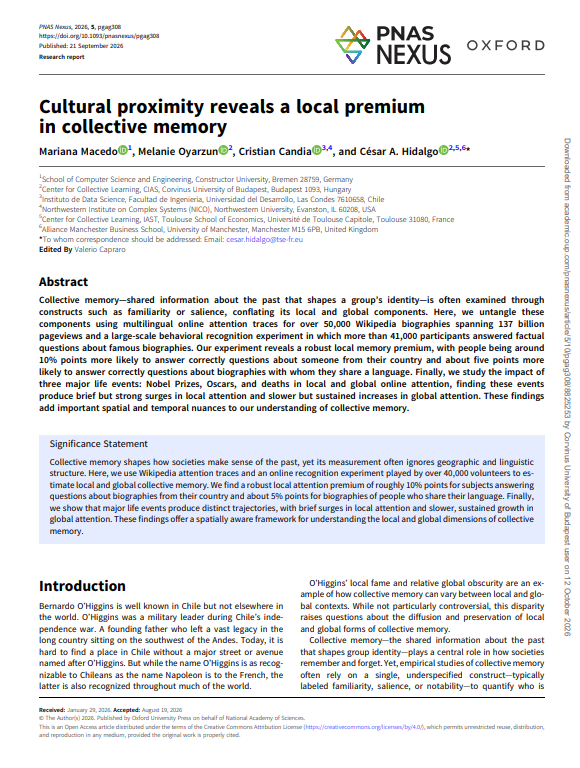
Pantheon is an observatory of human collective memory. It contains structured data on the biographies of more than 80k notable individuals. Pantheon was created at CCL in 2013 and is currently maintained and updated by Datawheel. The Center for Collective Learning continues to participate in the Pantheon project by performing academic research on collective memory and by exploring the design of new features that could enhance our understanding of human collective memory.